
Key Points
-
Tesla is hovering around an all-time high despite its core automotive business posting poor results.
-
Nvidia’s high margins enable it to invest aggressively in research and development without draining its cash flows.
-
Nvidia is a far better value than Tesla.
- 10 stocks we like better than Nvidia ›
Tesla (NASDAQ: TSLA) stock has been on a tear — hitting an all-time high on Dec. 15. Tesla is now within striking distance of surpassing Meta Platforms and Broadcom (NASDAQ: AVGO) in market capitalization to become the sixth-most-valuable U.S. company, behind only Nvidia (NASDAQ: NVDA), Apple, Alphabet (NASDAQ: GOOG) (NASDAQ: GOOGL), Microsoft, and Amazon.
Where to invest $1,000 right now? Our analyst team just revealed what they believe are the 10 best stocks to buy right now, when you join Stock Advisor. See the stocks »
Tesla is surging due to investor excitement over the company’s robotics and artificial intelligence (AI) investments — particularly its autonomous driving technology through its expanding robotaxi project. Investors are betting that Tesla’s future will depend less on selling electric vehicles (EVs) to households and more on self-driving cars, Optimus robots, etc.
But to fund these efforts, Tesla relies on cash flows from its automotive and energy generation and storage segments. Tesla’s profitability has taken a massive hit, as growth is slowing and its costs are rising. Its operating margins in the third quarter of 2025 were just 5.8% compared to 10.8% in the same quarter of 2024.
Tesla is being valued for what it could earn in the future rather than what it is earning today. Even if Tesla delivers exceptional results, it could still be a poorly performing stock over the next three to five years because so much optimism is already being factored into the valuation. A much better opportunity for 2026 and beyond is a company with plenty of growth potential but a much more realistic valuation — Nvidia.
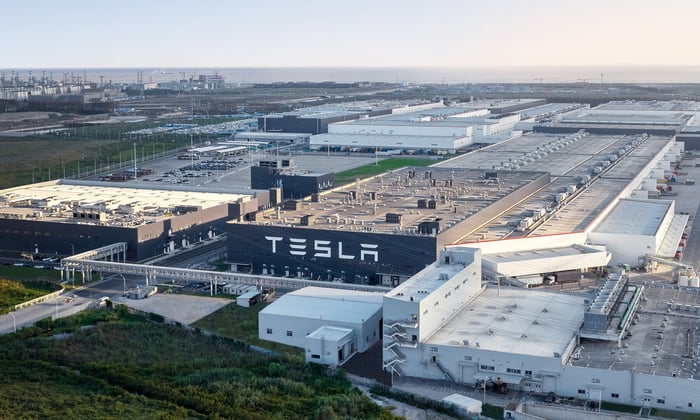
Image source: Tesla.
Nvidia’s cash flows fuel its innovation
Unlike Tesla, Nvidia is already capitalizing on a massive opportunity in AI by selling graphics processing units (GPUs) and associated software and hardware to data centers — a significant change from Nvidia’s previous key end markets in gaming, professional visualization, and automotive.
Nvidia has been in the spotlight lately due to mounting competition from Advanced Micro Devices and Broadcom. Broadcom works with hyperscalers like Alphabet to develop custom AI chips. Broadcom and Alphabet have been collaborating for several years, but the relationship has entered a new gear as Alphabet uses these custom chips to train AI models. Alphabet is considering selling its custom chips, called tensor processing units, to other hyperscalers like Meta Platforms. If Alphabet can rival Nvidia with a customer-built full-stack solution that doesn’t depend on its GPUs, it could erode Nvidia’s margins. That threat has been reflected in the stock prices of both companies — Nvidia is up just a couple of percentage points over the last three months, compared to a 21% gain for Alphabet.
Nvidia’s margins could fall, and it could still become the most profitable company (in addition to being the most valuable) in the world in the coming years. Nvidia has an exceptional balance sheet and generates tons of free cash flow that it can use to invest in long-term projects and ramp up research and development (R&D) spending.
Nvidia’s cash-supported R&D gives it a rapidly evolving product pipeline. It could have easily rested on its laurels after developing its Blackwell architecture. Instead, Nvidia plans to release its new class of GPUs, called Rubin, which are specifically engineered for AI systems. Rubin will use Taiwan Semiconductor Manufacturing‘s highly advanced 3-nanometer process, which packs more transistors into each microchip to increase performance.
Nvidia’s valuation is reasonable, while Tesla’s is built on speculation
With Tesla’s EV business under pressure, the company needs to begin generating positive cash flow from its other efforts to support long-term growth projects. Nvidia, on the other hand, is already a high-margin cash cow that is well-positioned to address mounting competition.
Additionally, Nvidia trades at a much more reasonable 37.2 times forward earnings. Tesla’s is a mind-numbing 292.9.
Nvidia and Tesla have both delivered impeccable returns for long-term investors. But for 2026, Nvidia has a far better profile of risk to potential reward than Tesla, which has a mountain to climb just to meet investor expectations and could get punished for even minor missteps.
Should you buy stock in Nvidia right now?
Before you buy stock in Nvidia, consider this:
The Motley Fool Stock Advisor analyst team just identified what they believe are the 10 best stocks for investors to buy now… and Nvidia wasn’t one of them. The 10 stocks that made the cut could produce monster returns in the coming years.
Consider when Netflix made this list on December 17, 2004… if you invested $1,000 at the time of our recommendation, you’d have $509,039!* Or when Nvidia made this list on April 15, 2005… if you invested $1,000 at the time of our recommendation, you’d have $1,109,506!*
Now, it’s worth noting Stock Advisor’s total average return is 972% — a market-crushing outperformance compared to 193% for the S&P 500. Don’t miss the latest top 10 list, available with Stock Advisor, and join an investing community built by individual investors for individual investors.
*Stock Advisor returns as of December 22, 2025.
Daniel Foelber has positions in Nvidia. The Motley Fool has positions in and recommends Advanced Micro Devices, Alphabet, Amazon, Apple, Meta Platforms, Microsoft, Nvidia, Taiwan Semiconductor Manufacturing, and Tesla. The Motley Fool recommends Broadcom and recommends the following options: long January 2026 $395 calls on Microsoft and short January 2026 $405 calls on Microsoft. The Motley Fool has a disclosure policy.
The views and opinions expressed herein are the views and opinions of the author and do not necessarily reflect those of Nasdaq, Inc.
#Stock #Buy #Tesla